By tracking your NPS score in Insurance, you reveal the critical difference between customers who stay because they're satisfied with price, and true brand advocates who remain loyal through renewal cycles.
Assessing your Net Promoter Score across key touchpoints, particularly during claims, means insurers can identify at-risk policyholders before they defect, demonstrate Consumer Duty compliance, and transform transactional relationships into long-term loyalty.
Key takeaways
-
NPS measures relationship strength rather than transaction satisfaction, making it uniquely suited to insurance's long-term, promise-based product model
-
Using NPS to segment passives from promoters can identify price-sensitive customers before they churn to cheaper competitors
-
Claims interactions serve as the true test of customer loyalty, often exposing detractors despite positive sales experiences
-
Verified NPS data creates audit-ready evidence of fair customer outcomes, supporting FCA Consumer Duty requirements
-
World-class insurance NPS scores (50+) correlate with lower churn and stronger organic growth through advocacy
Understanding the metric: What is NPS and why does it matter?
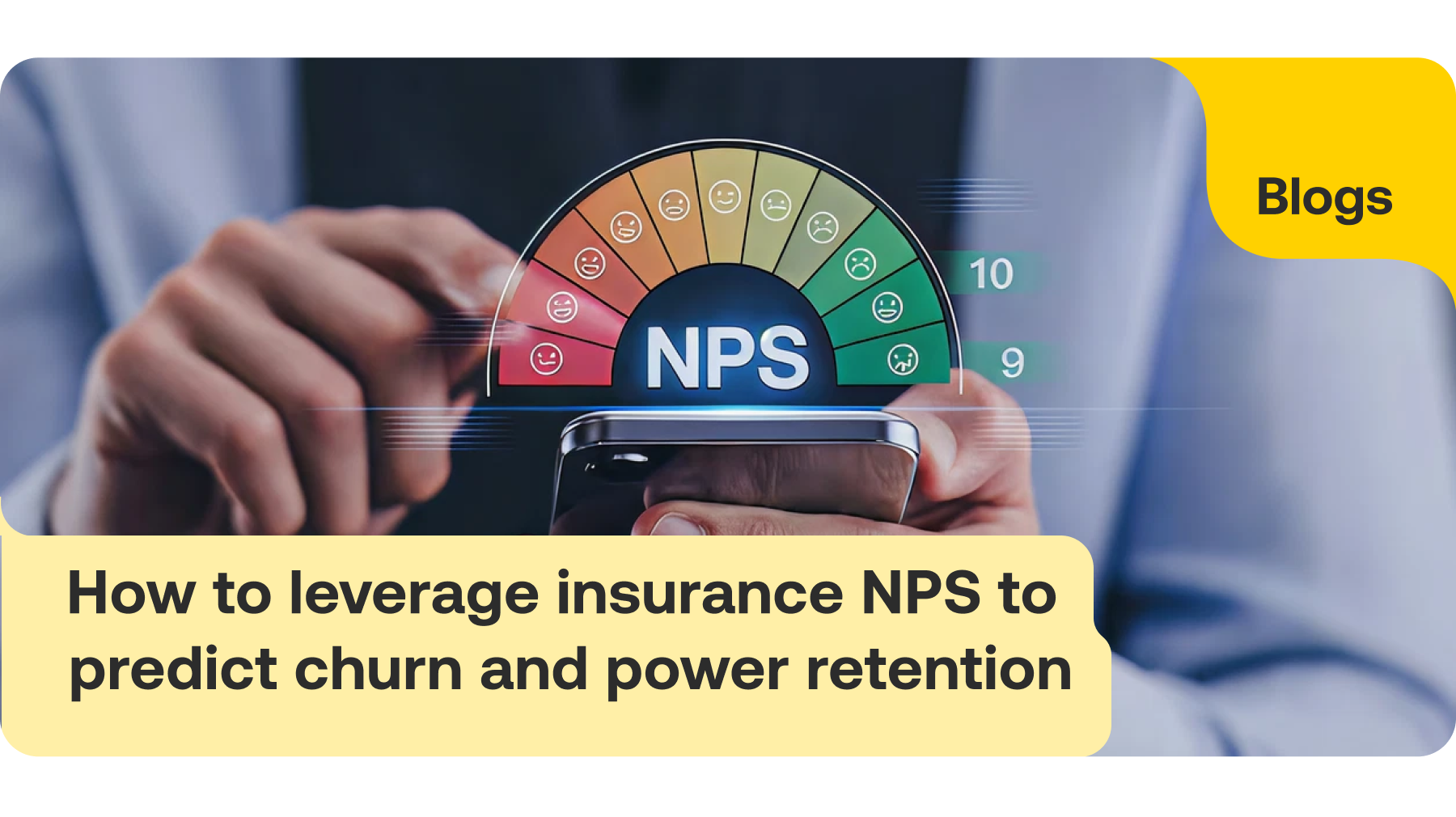
Net Promoter Score measures customer loyalty by asking one simple question: "How likely are you to recommend us to a friend or colleague?"
Respondents answer on a scale of 0-10.
-
Promoters (9-10) represent your advocates
-
Passives (7-8) are satisfied but uncommitted customers
-
Detractors (0-6) indicate those at risk of churning or actively damaging your reputation
The calculation is straightforward: subtract the percentage of detractors from the percentage of promoters to generate your NPS. E.g. if 20% are detractors and 50% are promoters, you’re left with 30% of customers who are advocates – giving you a score of 30.
While star ratings capture a moment (was this transaction satisfactory?) NPS scores are a great way to measure something broader: the health of the ongoing relationship between supplier and customer.. For an industry built on annual renewals and lifetime customer value, this distinction matters enormously.
A five-star rating for purchasing a policy tells you the process went smoothly. An NPS score tells you whether that customer will still be with you in three years. Using this information together enables you to highlight both immediate issues and long-term sentiment.
Beyond the score: Why NPS in insurance is your secret retention weapon
Many insurers confuse price satisfaction with brand loyalty. A customer might rate their experience highly because they secured a competitive premium, but this reflects market positioning rather than relationship strength. When a comparison site presents a slightly cheaper alternative at renewal, that "satisfied" customer disappears without hesitation.
Insurance presents unique challenges as an intangible product. Policyholders aren't buying something they can touch or immediately use – they're purchasing a promise of future service. An NPS score in insurance measures the customer perception of the strength of that promise and the trust underpinning it. Unlike tangible products where quality is immediately apparent, insurance relies entirely on perceived reliability and confidence in future claims handling.
Feefo's NPS tool allows insurers to segment your crucial passive customers – the 7-8 scorers who appear satisfied but lack emotional connection to your brand. These ‘passives’ represent your most vulnerable segment, who’ll stay while your price remains competitive but harbour no loyalty that would prevent switching.
By identifying this group before renewal season, you can implement targeted retention strategies rather than discovering their defection when it's too late.
Navigating regulation: How NPS supports Consumer Duty outcomes
The FCA's Consumer Duty has elevated customer feedback from marketing tools to regulatory necessity. Insurers must now demonstrate they're delivering good outcomes across the customer journey, proving fair value and appropriate support. The NPS insurance industry standard has become integral to this compliance framework.
Consumer Duty requires firms to evidence that
- Customers receive fair value
- Understand what they're buying
- Get the support they need.
Traditional metrics struggle to capture these holistic outcomes, but NPS – particularly when tracked across multiple touchpoints – reveals whether customers genuinely believe they're receiving fair treatment.
Feefo provides verified, audit-ready feedback trails that compliance officers can present to regulators. Every response is purchase-verified, ensuring authenticity and eliminating concerns about fake reviews or cherry-picked testimonials.
When regulators question whether your claims process delivers good outcomes, you can present data showing how customers rate their experience at that critical moment, along with the actions you've taken to address any concerns raised.
The claims 'moment of truth': Identifying your true promoters
Insurance operates as a passive product for most of its lifecycle. Customers pay premiums month after month, year after year, with minimal interaction. The claim represents the first, and often only time, they truly "consume" the service they've been funding. This moment reveals whether your brand promise holds up under pressure.
LV= demonstrated the power of transparency in building trust, achieving a 28% increase in start quote rates by showcasing verified customer feedback. Their success highlights how visible proof of claims handling quality influences both retention and acquisition.
The kitchen ceiling collapsing because someone left the bath running, a stationery car being totalled or even a less tragic medical appointment; offering the policy-holder a simple, painless experience that helps solve their claim, means that they are more likely to stay with you even with cheaper alternatives as you’re “worth the money”.
By implementing multi-touchpoint NPS measurement through Feefo, insurers can identify whether their claims process creates detractors even when the initial sales experience earned five stars.
This insight proves critical.
A customer might score 9/10 when purchasing their policy, impressed by your website's usability and competitive pricing. But if their claim experience six months later scores 3/10 due to delayed responses or unclear communication, they've transformed into a detractor who will share their frustration publicly and switch at renewal. Multi-touchpoint NPS tracking captures this deterioration before it's too late.
Benchmarking the market: What does a 'winning' NPS score insurance look like?
Understanding where your score positions you in the market helps set realistic targets and identify improvement opportunities.
|
NPS score range |
Classification |
What it means for your business |
|
Below 0 |
Poor |
High churn risk; brand reputation is likely being damaged through negative word-of-mouth |
|
0 - 30 |
Average |
Standard for the insurance industry, but vulnerable to price-based competition and limited differentiation |
|
31 - 50 |
Good |
Strong customer loyalty; healthy organic growth through word-of-mouth and improved retention rates |
|
50+ |
World-class |
Exceptional service delivery; these brands lead the market in retention and can command premium pricing |
Feefo offers more than your NPS score. The platform also provides AI-driven sentiment analysis that explains why customers score as they do. This intelligence allows you to benchmark against competitors accurately whilst understanding the specific drivers of your score.
You might discover your claims team excels but your renewal communication frustrates customers, or that your digital experience delights younger policyholders whilst older customers struggle with online self-service.
From insights to income: Transforming your insurance business with Feefo
Verified feedback platforms build significantly more trust than open review sites where authenticity remains questionable. When Events Insurance and other forward-thinking insurers showcase purchase-verified reviews, prospective customers recognise the difference between genuine policyholder experiences and potentially manufactured testimonials.
The cost of customer acquisition in insurance continues rising, making retention your most profitable growth strategy. Yet many insurers remain blind to the warning signs that predict churn, relying on trailing indicators like cancellation rates rather than leading indicators like declining NPS scores or passive customer segments.
Feefo's integrated NPS surveys reduce churn by identifying at-risk policyholders before they defect, whilst demonstrating the Consumer Duty compliance that regulators increasingly demand.
Book a demo to discover how purchase-verified feedback and multi-touchpoint NPS measurement can transform your retention rates and turn grudge purchases into lasting relationships.
And for more information on NPS, watch our Masterclass on How to Measure Customer Sentiment.