The way customers find and evaluate businesses has changed. AI-powered search tools are delivering direct answers rather than lists of links.
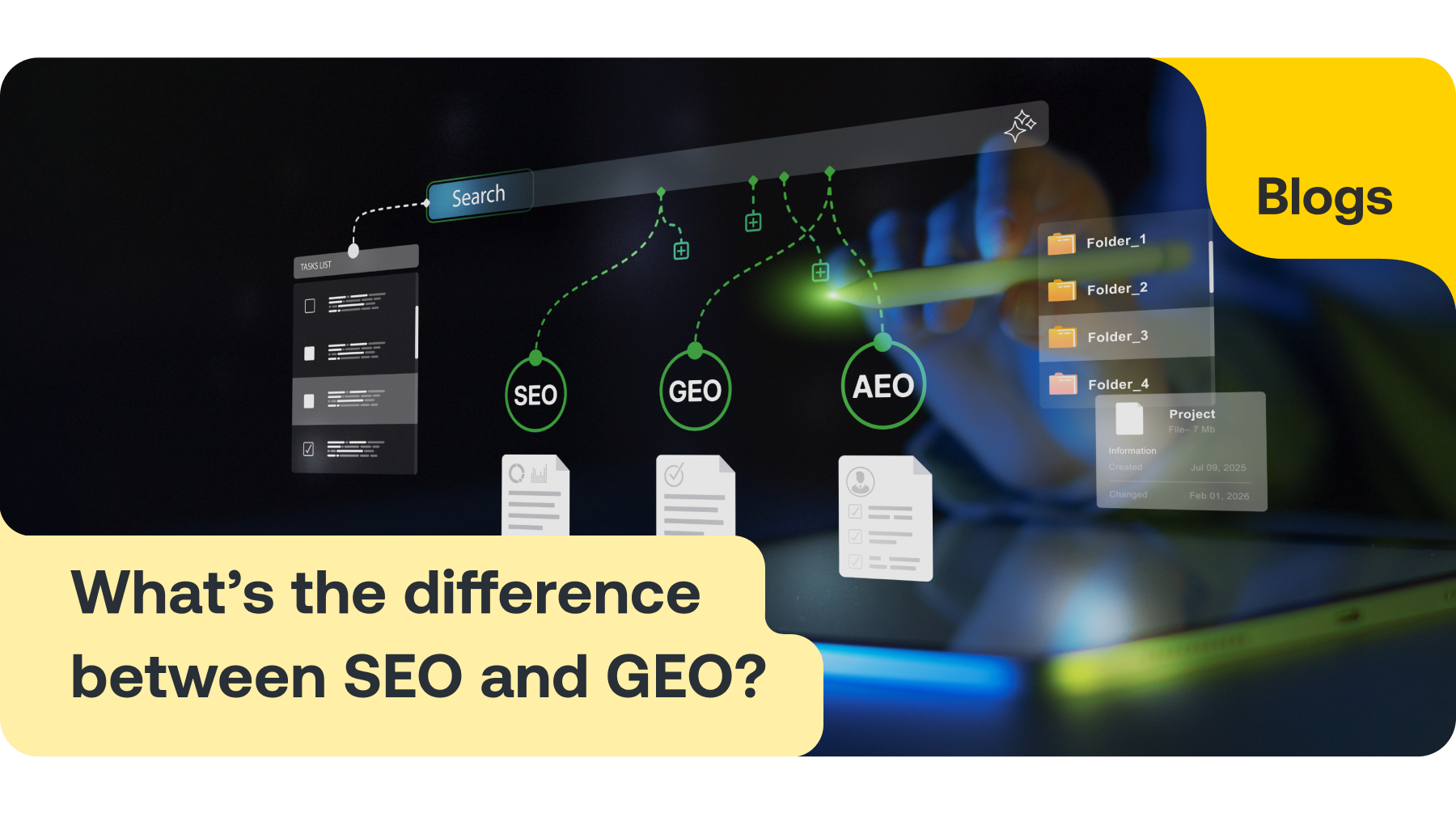
GEO (Generative Engine Optimisation) and its cousin, AEO (Answer Engine Optimisation) are a large part of this new reality. They build on the foundations of traditional SEO – relevance, clarity, trust – and adapt them for a world where AI, not search rankings, is the first point of contact between a customer and a company.
As AI-generated answers become a more common starting point for product, service and brand discovery, marketers need to understand how they can influence visibility for their brand, beyond traditional search rankings.
Key Takeaways
- SEO and GEO share the same goal: helping customers find useful information, but they optimise for different outcomes.
- AI-powered search is changing discovery, with more users receiving answers directly rather than clicking through to websites.
- GEO focuses on entities, while SEO focuses on pages and rankings.
- Verified reviews and structured data help AI tools understand products, services and reputation more accurately.
- Businesses that are easiest for AI to verify and understand are more likely to appear in AI-generated recommendations.
What is SEO?
SEO (Search Engine Optimisation) is the practice of improving your visibility in traditional search engines, like Google. It focuses on making your content easier to find, understand and rank – matching user queries to relevant pages through keywords, high-quality content, technical performance and authority signals such as backlinks and verified reviews.
In simple terms, SEO helps search engines decide which pages to show, in what order, based on how well they answer a user's question.
What is GEO?
GEO (Generative Engine Optimisation) helps AI-powered search tools understand and recommend your company accurately.
Where SEO optimises pages for rankings, GEO focuses on the underlying data those AI models rely on – your product information, business details, review signals, and how clearly your company is defined as an entity.
GEO helps AI systems deliver accurate answers that include your business when customers ask real-world questions.
Hang on, what is AEO?
AEO (Answer Engine Optimisation) is closely related to GEO but has a specific focus: structuring your content so that search engines and AI tools can extract and surface direct answers to user questions.
Where GEO is concerned with how AI models understand an organisation as a whole, AEO is about ensuring your content is formatted to win those answer placements – featured snippets, voice search responses, and the answer boxes that appear in AI-generated results.
In practice, the two disciplines overlap significantly, and most teams will find they inform the same underlying work: clean structure, clear language, and content that answers real customer questions precisely.
Where SEO, GEO and AEO overlap
Despite the shift to AI-driven search, SEO, GEO and AEO share the same core principles: helping customers find reliable, relevant information at the right moment. Both reward businesses that answer real customer questions clearly, maintain accurate information and provide a consistent experience across their digital presence. High-quality content, strong technical foundations, credible review signals and clear site structure all matter across all three. Trust and usefulness still matter. The difference is that they now influence both search rankings and AI-generated answers.
SEO vs GEO: What's the difference?
The difference between SEO and GEO is in what each discipline optimises for. SEO is built around web pages – making them visible and highly-ranked for keyword-based queries. GEO is built around entities – making your company, products and services understandable and trustworthy enough for an AI model to include them in a generated answer.
|
|
SEO |
GEO |
|
Built around |
Web pages |
Entities (brands, products, services) |
|
Goal |
Higher rankings in search results |
Inclusion in AI-generated recommendations |
|
Measures success by |
Rankings, clicks, traffic |
Mentions, citations, recommendations |
|
Key signals |
Keywords, backlinks, technical SEO |
Structured data, reviews, entity consistency |
|
Optimises for |
Search engines |
AI models and answer engines |
SEO rewards links and keyword relevance. GEO rewards data accuracy, entity clarity and verified customer insight that AI models can ground their responses in. SEO is about appearing in results; GEO is about being understood, trusted and recommended in AI-generated answers.
A company can rank well in traditional search while being poorly surfaced – or entirely absent – in AI-generated answers. The signals that earn a Google ranking and the signals that earn an AI citation are related, but they're not the same. Structured data, review quality and entity consistency are doing more of the work in GEO than a well-optimised title tag.
Why purchaser-verified customer reviews matter more than ever
AI search tools rely on verified, structured data to decide which businesses to surface. Customer reviews are particularly valuable because they provide independent evidence of real-world experience, satisfaction and product performance.
It’s not enough to just have reviews. The accuracy, detail and verification behind them now directly influence how AI models interpret your products, sentiment and overall credibility.
Structured data and schema markup make this possible by turning reviews into machine-readable signals. When marked up correctly, reviews can be accurately understood and surfaced by AI and search engines — rather than inferred or overlooked.
AI-powered search tools value reviews because they often contain information that isn't included in a product or service description, such as:
- Who it is for
- Which alternatives people considered
- How it performs in practice
- What customers liked and disliked
Platforms such as Feefo, with purchaser-verified reviews and rich metadata, provide the structured, reliable signals that AI systems use to understand products, services and customer experience.
Because every review is tied to a confirmed purchase, the data is clean and attributable, providing the type of grounded, traceable insight that generative engines prefer when deciding what to surface.
The result is a more accurate picture of your business and customer feedback that performs across both traditional and AI search.
How to optimise your customer review content for AI Search
For AI models, the value of a review lies in its detail, as much as its star rating. A review that explains what the customer was looking for, what alternatives they considered, and what specifically met their needs provides meaningful signals for an AI model.
That’s why the questions you ask matter. Customers respond to the prompts they’re given: vague questions produce vague answers. Specific, decision-focused questions generate the kind of structured detail that feeds into how AI models understand and describe your products.
Questions worth building into your feedback requests include:
- "What were you looking for when you chose this product or service?"
- "Who would you say this is best suited for?"
- "What alternatives did you consider before choosing us?"
- "What would you tell someone who was thinking of buying this?"
- "What surprised you most – positively or negatively?"
The answers to these questions serve two purposes: they make reviews more useful to future customers, and they generate specific, contextual, entity-level data that AI models rely on when suggesting a product or brand.
This is where the mechanics of how you collect feedback and GEO are directly aligned. Better questions produce better reviews and better reviews lead to more accurate AI recommendations.
Investing time in better questions improves the quality of your review data, making it more useful for customers, search engines and AI tools alike.
Read our guide on How to Collect Feedback for more insights.
What GEO Looks Like in Your Sector
GEO plays out differently depending on how your customers search and decide. Here's how it's emerging across four key industries – and what it means in practice.
GEO in Retail
Shoppers are asking conversational questions about product quality, sizing and suitability before they even reach a product page.
GEO helps ensure that AI answers reflect your products accurately. Verified reviews that cover specific attributes such as fit, durability, packaging and ease of use, give AI models the valuable detail missing from star ratings.
Typical queries:
- "Which running shoes are best for wide feet?"
- "Are these headphones worth the money?"
- "How does the sizing come up on this jacket?"
GEO in Travel
Customers increasingly ask AI for destination recommendations, hotel comparisons and policy information, often at the point of deciding where to spend significant amounts of money.
Verified, detailed feedback – for example, covering specific experiences like room quality, transfers or customer service responsiveness – helps models represent your offering correctly.
Typical queries:
- "What's the best hotel for families in Tenerife?"
- "Is this airline reliable for long-haul?"
- "What do customers say about this tour operator?"
GEO in Financial Services & Insurance
Customers use AI to compare cover, interpret policy language and assess whether a provider is reliable. AI models need clean, consistent, verifiable data to describe financial products accurately. Ambiguous or outdated information – whether in policy documentation, product listings or review content – creates the conditions for AI hallucination.
Verified reviews that speak clearly to claims experience, customer service quality and policy transparency give models something reliable to work from.
Typical queries:
- "Which car insurer has the best customer service?"
- "Does this policy cover pre-existing conditions?"
- "Is this provider reliable for young drivers?"
GEO in Automotive
Buyers ask about reliability, ownership cost, dealership experience and model comparisons, often months before they make a decision. What AI tools surface during that research phase can shape consideration sets before a customer has spoken to anyone.
GEO means ensuring AI draws on verified ownership and service experience – not forums or outdated content. Reviews covering handover, servicing and long-term reliability provide the grounded data AI prefers.
Typical queries:
- "Is the [model] reliable long-term?"
- "What's the customer service like at this dealership?"
- "How does the [model] compare to [competitor] for running costs?"
How to set your brand up for GEO success
Businesses that perform well in AI search tend to have four things in place: accurate data, consistent entity signals, structured content and verified customer feedback.
That means ensuring your product and company information is consistent everywhere it appears, investing in reviews that capture specific, decision-relevant detail, and using JSON-LD schema markup to make that content machine-readable. It also means monitoring how AI tools currently describe your company – and closing the gaps where the picture isn't accurate.
Because GEO spans SEO, content, CX and product, it works best as a cross-team effort, typically led by marketing.
Summary
SEO isn't going anywhere. But it no longer tells the full story of how customers find, evaluate and choose brands. As AI-powered search becomes a routine part of the discovery process, visibility in generated answers is becoming as commercially significant as visibility in ranked results – and the signals that drive it are different enough to warrant their own attention.
The core shift is this: where SEO asks "can search engines find and rank my content?", GEO asks "can AI models understand and trust my business enough to include it in an answer?" Those are related questions, but they're not the same question. Brands that treat them as identical risk being well-ranked but poorly recommended where it increasingly matters.
Verified reviews and structured review data sit at the centre of that challenge. They give AI models something precise and trustworthy to work from – grounded in real customer experience, tied to confirmed purchases, and marked up in a way that makes it machine-readable. That's not a new category of marketing asset. It's an existing one that now carries more weight than most teams have yet factored in.
Book a consultation | Explore our pricing | View our AI Advantage Bundle
Frequently asked questions
What is the difference between SEO and GEO?
SEO focuses on improving visibility in traditional search engine results. GEO focuses on helping AI-powered search tools accurately understand your products, services and reputation.
What is AEO vs SEO?
SEO helps search engines discover, index and rank content. AEO (Answer Engine Optimisation) focuses on structuring content so search engines and AI tools can surface direct answers through featured snippets, voice search and AI-generated responses.
Is GEO replacing SEO?
No. SEO remains essential for helping customers discover content through traditional search. GEO builds on those foundations by helping AI systems understand and trust your company when generating answers.
How do customer reviews support GEO?
Verified customer reviews provide trustworthy, structured signals that help AI systems understand products, services and customer sentiment. Detailed reviews can improve how accurately a brand is represented in AI-generated answers.
Why is structured data important for AI search?
Structured data helps search engines and AI systems interpret information consistently. It provides machine-readable context that improves confidence in how businesses, products and reviews are understood and surfaced.
What should marketers prioritise first for GEO?
Focus on accurate business information, consistent brand data, structured markup, verified customer reviews and content that clearly answers customer questions. These foundations support both traditional SEO and AI-driven search visibility.