WhatsApp is already one of the most used communication channels in the UK – and brands that have adopted it for feedback collection are seeing response rates that email alone can't match.
Zoe Shackall and Charlotte McDougall recently hosted a product showcase session on how adding WhatsApp to your collection strategy gives customers a faster, more natural way to share feedback, with measurable results across retail, travel, and financial services.
Here are the key insights from the session – plus the results early adopters are already seeing.
Key takeaways
- WhatsApp review requests have driven an 84% increase in response rates compared to email
- Conversational feedback flows – where each question arrives as a message – produce higher completion rates than traditional form-based surveys
- Limiting requests to five questions reduces survey fatigue and produces feedback that more accurately reflects your full customer base
- In retail, response rates have reached 27%; travel brands have seen a 15% uplift; and financial services firms like Optimyze Finance have achieved 33%. Across sectors, the results are consistently higher than traditional channels
- WhatsApp works alongside email, not instead of it – fallback routing ensures no feedback opportunity is missed
Can WhatsApp improve feedback response rates?
Email remains a reliable and cost-effective collection channel for most brands – but inboxes are crowded. Feedback requests compete with promotional and transactional messages, and even well-timed sends can struggle to land when customers are busy or on the move.
The average person spends over four hours a day on their mobile, with 81% of consumers checking their messages within five minutes. WhatsApp – used by over 90% of UK adults monthly, forms a key part of this behaviour. Messages are seen quickly, acted on swiftly, and the channel makes frictionless replies easy.
That's the core argument for adding WhatsApp to your collection strategy. It’s: not about replacing what works, but reaching the customers that don’t respond to email.
How WhatsApp feedback collection works
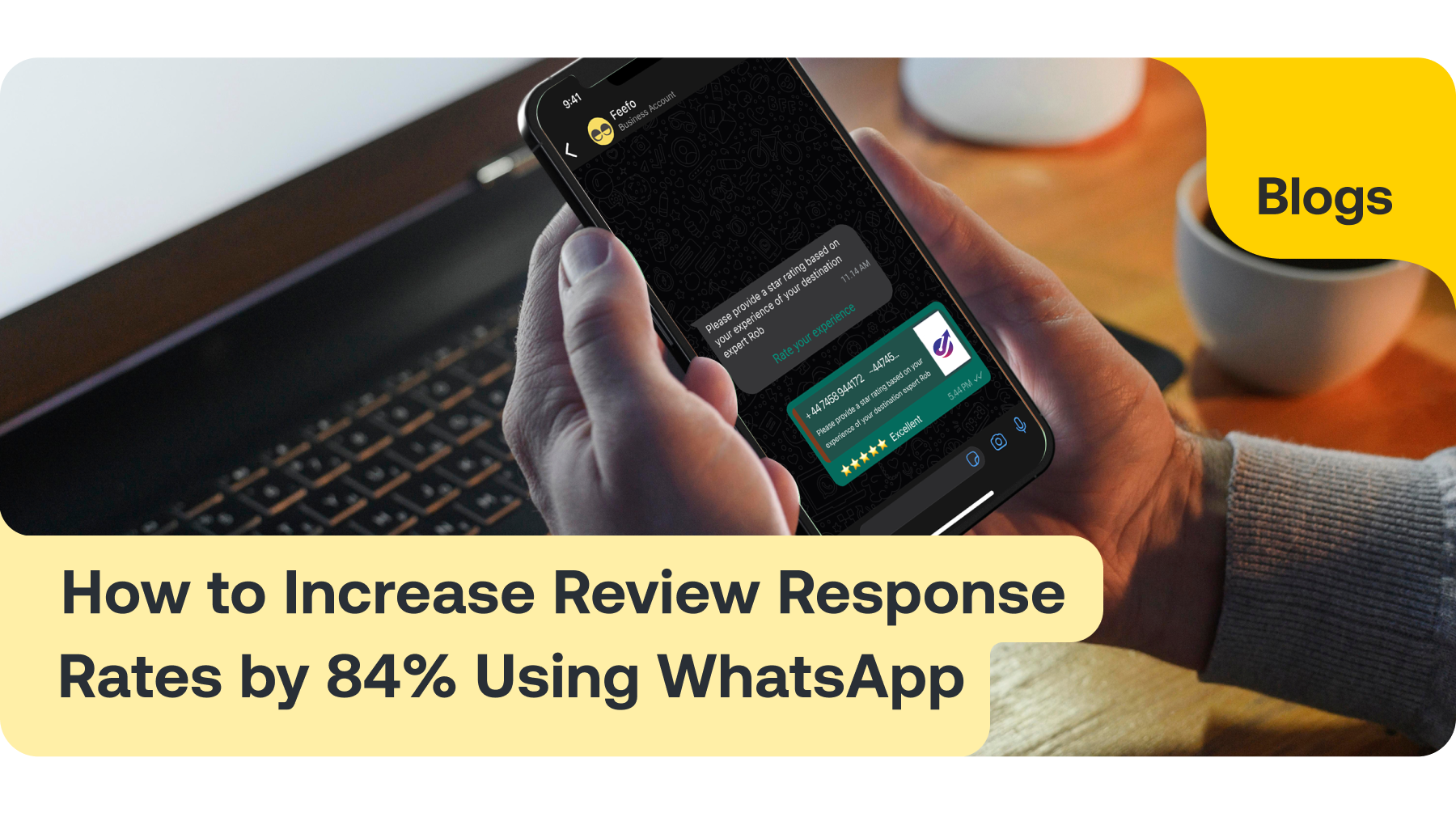
The customer experience is straightforward. Instead of a dedicated form, they receive a message, with each question arriving as a natural part of that conversation. It feels like an exchange rather than a form, which is a large part of why completion rates are higher.
Features of the Feefo WhatsApp flow especially worth highlighting:
- Consent-first by design. Every interaction begins with an opt-in message, ensuring compliance with Meta's policies and giving customers control from the outset. This matters particularly in regulated sectors where trust is a condition of the relationship.
- Short, focused question sets. Flows are capped at five targeted questions. This isn't a limitation – it's the mechanism. Shorter requests produce higher completion rates and less survey fatigue, which means the data you collect is more representative of your actual customer base.
- Flexible question formats. Star ratings, written feedback, NPS, and custom questions can all be incorporated – allowing you to tailor each flow to a specific product, service, or moment in the journey.
- Built-in nudges. If a customer starts but doesn't finish, a gentle reminder can be triggered within WhatsApp. Partial responses are retained even where a review isn't completed.
- In-app media uploads. Customers can submit photos and videos directly within the conversation. This has driven a measurable increase in UGC volume among early adopters – content that feeds directly into on-site and social proof.
- Fallback routing. If a customer doesn't use WhatsApp, requests are automatically redirected to email. Coverage is maintained without any manual intervention.
What brands are seeing in practice
Early adopters across sectors are reporting results that go beyond incremental improvement.
In retail, response rates have reached 27.3% – particularly strong for higher-value purchases where reviews play a direct role in building confidence for future buyers.
In travel, brands capturing feedback immediately after specific experiences – an excursion, a check-in, a transfer – rather than waiting until the end of a trip, have seen a 15% uplift in responses. Timing and context make the difference; WhatsApp makes both possible.
In financial services, Optimyze Finance achieved a 33% response rate – evidence that conversational feedback collection works even in sectors where customer communication is traditionally more formal and regulated.
Across all three sectors, brands are also reporting an increase in visual user-generated content (UGC), with customers sharing photos and videos directly within the app. For retail and travel in particular, this content has immediate application across product pages and social channels.
Adding WhatsApp to your feedback strategy
Customers who don't open emails, who are mid-journey when the request arrives, or who simply respond better to conversational formats represent real feedback that isn't currently being captured.
WhatsApp fills those gaps without disrupting what's already in place. Combined with email through fallback routing and reminder flows, it extends your reach without adding complexity to your operations.
If you'd like to see how it works in practice, you can watch the full showcase session below.
Book a consultation · Explore our pricing