UGC — photos, videos and reviews from real customers — answers the question every buyer is actually asking: does this work for someone like me? Brands that embed it directly into their website see measurable lifts in conversion, dwell time and add-to-basket rates.
Feefo Social is built to make that simple. Our Senior Product Manager Ottilie and Senior Business Development Manager Beth recently hosted a LinkedIn Live on exactly this topic — here's what you need to know.
Key takeaways:
-
Nine in ten shoppers are more likely to buy a product when they can see photo and video content from real customers
-
UGC converts better than branded content because it reflects genuine experience, not a curated brand narrative
-
Embedding UGC directly on your website – on product pages, homepages and category pages – drives measurable increases in conversion and time on site
-
Feefo Social collects, curates and displays verified visual UGC from Instagram, TikTok and direct uploads, with automated rights management built in
-
Shoppable UGC works across sectors – retail, travel, automotive and hospitality – not just direct-to-consumer brands
What is UGC – and why does it convert better than branded content?
User-generated content is any content created by your customers rather than your brand – photos of a product in someone's home, a video from a hotel balcony, a review posted after a test drive. It exists whether you actively collect it or not; the question is whether you're putting it to work.
The reason it converts is straightforward.
-
Branded content tells people what you want them to think.
-
UGC shows them what real customers actually experienced.
In a market saturated with polished studio photography and AI-generated copy, authenticity has become the differentiator – and consumers know the difference.
Nine in ten shoppers are more likely to buy a product when they can see photo and video content from real customers. That figure reflects something most marketing directors already sense: the moment a potential customer sees someone like them using a product, the decision gets easier.
That dynamic holds across sectors. A video of someone receiving their new car carries different weight to a spec sheet. A guest's poolside photo does more for a hotel booking page than any professionally shot campaign image. A fashion brand showing how a dress fits on a range of real body types answers the question a model shot never can.
The shift doesn't mean abandoning brand content, it means placing more emphasis on what type of content works best at which stage of the journey. UGC does its best work nearer the point of decision.
What kinds of UGC can you put on your website?
The short answer is: more than most brands are currently using.
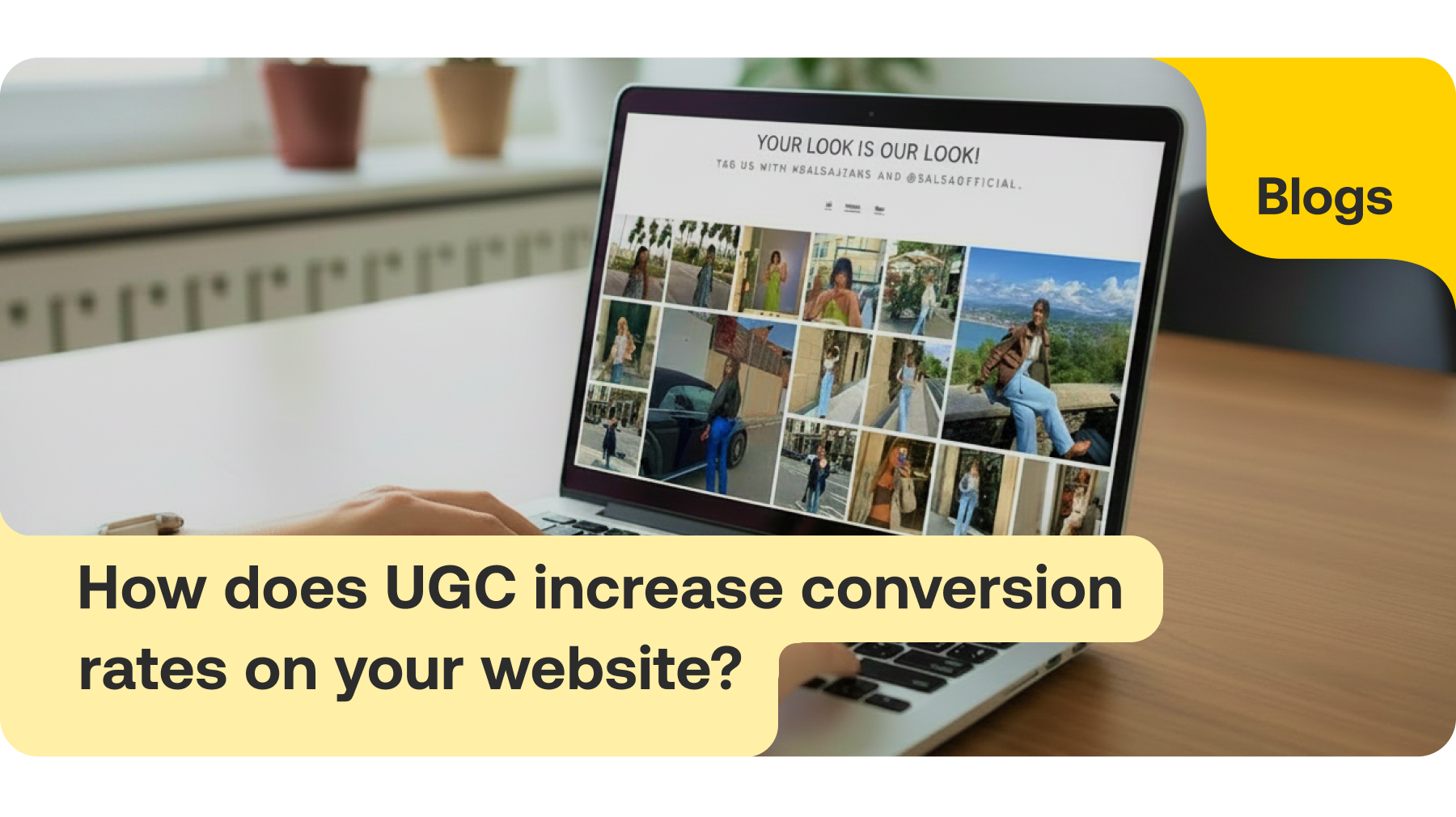
The most common starting point is photo and video content pulled from social channels – Instagram posts, TikTok videos, tagged brand content – displayed in galleries on your website. Done well, this turns your product pages and homepage into a living feed of real customer experience rather than a static catalogue.
Beyond galleries, there are a few formats worth knowing about:
-
Shoppable galleries link UGC directly to product pages, so a customer who sees a photo they like can add the item to their basket in one click. The path from "that looks good" to "I'll take it" becomes frictionless.
-
Carousels work well on homepages and category pages – a rotating selection of customer content that gives browsers a reason to stay on the page longer without interrupting the journey.
-
Product page widgets sit alongside reviews and product information at the point where purchase decisions are made. This is where UGC has the most direct impact on conversion.
The placement matters as much as the format. Content that performs on a homepage – lifestyle imagery, brand mood – is different to what converts on a product detail page, where specificity and authenticity do the heavy lifting.
Feefo Social supports all of these formats, with layout options – grids, collages, carousels – that inherit your site's fonts and branding automatically. The widget goes on once; everything updates dynamically from there.
How does Feefo Social work?
Feefo Social is built around three stages: collect, curate, and display. Each step is managed through the Feefo hub – the same environment existing Feefo clients already use – so there's no separate platform to learn or manage.
Collect
You start by choosing where your UGC comes from. Feefo Social connects to Instagram and other social channels, pulling content via hashtags, tagged accounts, or brand-specific campaign tags. Before you commit to a collection, you can see the volume of content available – useful if you're building around a seasonal campaign or a specific product line and need to know what you're working with.
You can also import content you already own – brand assets, influencer content, or imagery from existing partnerships – and blend it with organic UGC in the same widget.
Curate
Not all content that comes in will be right for your site. The curation stage gives you full control – pin posts you want to feature prominently, hide anything that doesn't meet your brand standards, and block specific accounts if needed. You can also tag products directly from your catalogue, so a customer's photo of your product links straight to the relevant page.
Rights management is handled automatically. Before customer content appears on your site, permission is requested from the original creator – without your team having to chase it manually.
Display
Once you're happy with your collection, a single code snippet goes onto your site. From that point, any changes you make in the hub – new content, layout adjustments, refreshed posts – update on your site automatically, typically within seconds. No reintegration, and no developer dependency for routine updates.
The widget is fully customisable: layout, fonts, colours, and CTAs all adapt to your brand. For businesses where the goal isn't a direct sale – automotive, travel, hospitality – the CTA is flexible too. "Book a test drive", "Request a brochure", "Check availability" – whatever drives the high-value behaviour you're optimising for.
Does UGC on your website actually improve conversion rates?
The short answer is yes – and the numbers are specific enough to be useful in a business case.
Brands using Feefo Social see an 8.5% uplift in overall conversion rates, a 20% reduction in bounce rates, and up to 30% higher product page-to-basket conversions in retail and fashion. These figures reflect what happens when a browser sees the content they need to answer a final objection – and it pushes them to purchase.
A shopper on a product page has already done enough research to be there. What they need at that point isn't more brand messaging – it's confirmation that the product delivers in real life. A photo from a genuine customer, a video of someone using it, a gallery showing how it looks in different settings: these close the gap between interest and purchase in a way that copy and studio photography rarely can.
Dwell time matters too. The longer someone spends on a page, the more likely they are to convert – and UGC galleries give browsers a reason to stay. A 20% reduction in bounce rates is the measurable consequence of content that holds attention rather than losing it.
For non-retail sectors the dynamic is slightly different but the principle holds. In travel, UGC moves people from browsing destinations to booking. In automotive, it shifts window shoppers towards showroom visits. The conversion event changes; the role of social proof in getting people there doesn't.
How do you make sure the UGC on your website is trustworthy?
Putting customer content on your website only works if that content is genuine. Staged or misleading UGC doesn't just fail to convert – it actively damages trust when audiences spot it, and under the UK's Digital Markets, Competition and Consumers Act, using fake or unverified reviews carries real regulatory risk.
There are three things that need to be in place for UGC to be trustworthy at scale: rights, moderation, and verification.
-
Rights: mean you have explicit permission from the content creator to use their material on your site. Feefo Social handles this automatically – permission requests go out as content comes in, and nothing is displayed without confirmation. Your legal exposure is managed without your team having to track it manually.
-
Moderation: means you control what actually appears. Every piece of content passes through your curation stage before it goes live. You decide what gets pinned, what gets hidden, and which accounts to block entirely. The feed on your site reflects your brand standards – not an unfiltered scrape of everything tagged with your name.
-
Verification: is where Feefo's broader platform adds a layer that pure UGC tools can't match. Feefo reviews are only ever invited from verified purchasers – so when written reviews sit alongside visual UGC on your site, the entire content picture is anchored to real transactions. That's a meaningful trust signal for consumers who've learned to be sceptical of open review platforms.
Together, these three elements mean the UGC on your site is something you can stand behind – commercially, legally, and reputationally.
See Feefo Social in action
Your customers are already creating content about your brand. Feefo Social gives you the tools to collect it, curate it, and put it to work where it matters most – on your website, at the point of decision.
Whether you're starting from scratch or looking to build on an existing UGC strategy, we can show you exactly how it works for your sector and your site.
Book a consultation to talk through how Feefo Social can work for your brand, or explore our pricing to see what's included at every level.