According to Nielsen, 92% of consumers trust recommendations from people they know over any other form of advertising. UGC ads – paid advertisements that feature real customer content rather than brand-produced creative content – tap directly into that trust. For social media managers looking to improve ad performance without inflating production budgets, they represent one of the most cost-effective tools available.
Key takeaways
- UGC ads are paid advertisements featuring real customer content. They consistently outperform brand-produced creative on click-through rate, cost-per-click, and engagement.
- 92% of consumers trust peer recommendations over any other form of advertising, making verified customer content one of the most persuasive assets in a paid social strategy.
- Using customer content in paid ads requires explicit rights and permissions, not just a published review or a tagged post.
- TikTok UGC ads perform best when they feel native to the platform: unpolished, first-person, and indistinguishable from organic content.
- Pairing UGC ads with verified reviews creates a trust loop that moves customers from awareness to conversion with less friction.
What are UGC ads?
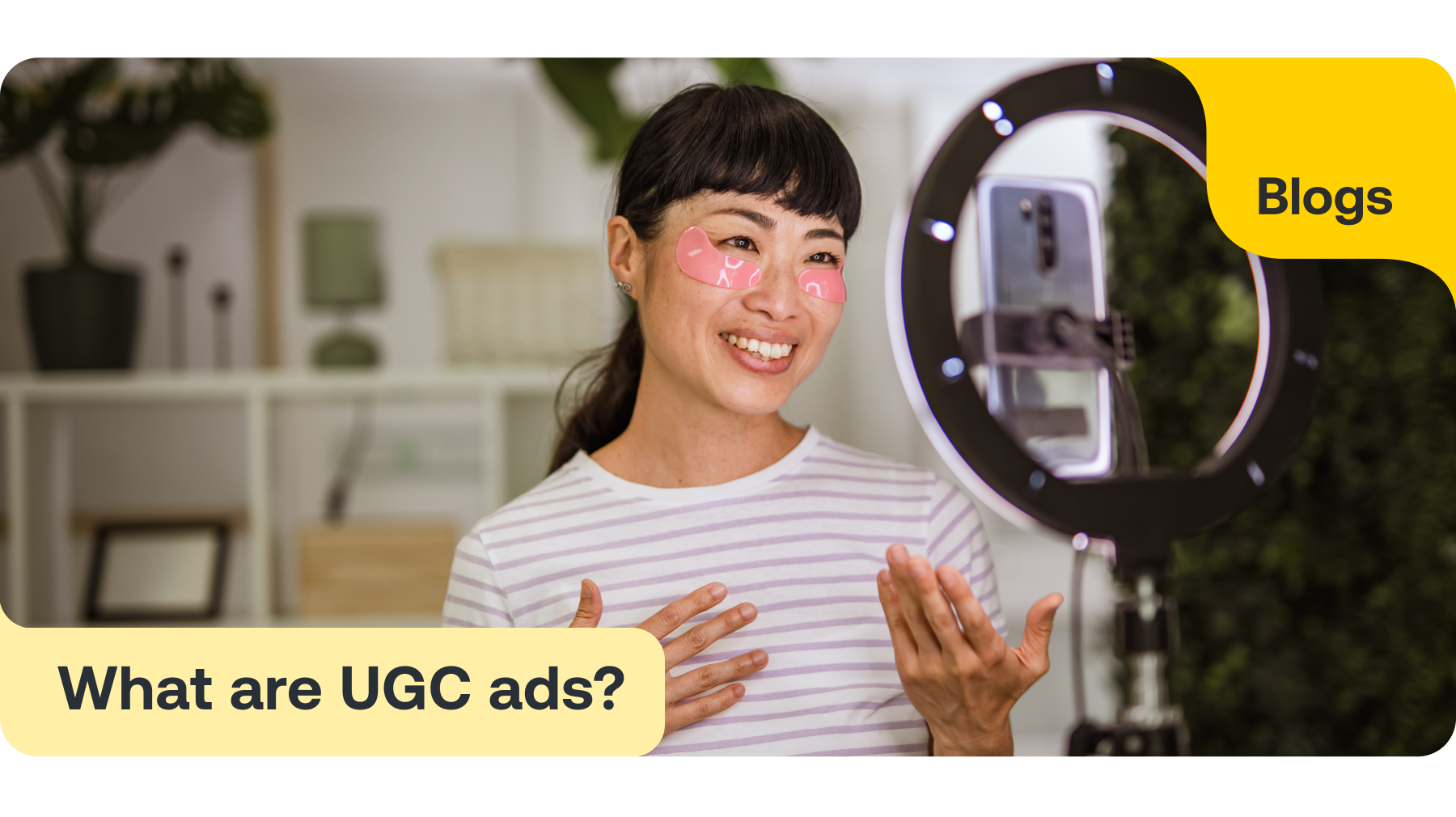
UGC ads are paid advertisements that feature content created by real customers – videos, photos, reviews, and testimonials – rather than brand-produced creative. They're designed to feel native to the platform they appear on: less polished than a studio shoot, more like something a friend might post.
That's precisely why they perform. Research consistently shows that UGC-based ads achieve 4x higher click-through rates than standard brand creative, with a 50% reduction in cost-per-click. Audiences respond to content that feels real – and UGC ads deliver that at scale, without the production overhead of traditional campaigns.
The shift to authenticity: What are UGC ads in the modern marketing funnel?
UGC ads do something traditional advertising struggles to replicate. They move the customer from awareness to purchase by showing that real people are already using and valuing the product. According to Stackla, 90% of consumers say authenticity is important when deciding which brands to support. UGC ads deliver that authenticity directly into the paid media environment.
For social media managers, that has a practical implication beyond trust. Because user-generated content is faster and cheaper to produce than traditional creative, brands can test multiple hooks, formats, and audiences rapidly – finding what converts without committing to expensive production budgets. A single piece of customer content can run as a paid ad, appear in an email campaign, sit on a product page, and be repurposed across organic channels. That kind of versatility is difficult to achieve with studio-shot creative.
Why UGC video ads outperform static creative
Video has become the default format for social discovery – and UGC video ads sit at the intersection of the two things that drive performance: format and authenticity.
The numbers reflect this.
- UGC earns 28% higher engagement than branded content on average.
- Among Gen Z specifically, 80% rely on user-generated videos to guide their purchase decisions, according to Statista.
- According to Emplifi's Impact of UGC Report, consumers who engage with UGC are 4.9x more likely to return to a site – making it a retention tool as much as an acquisition one.
For social media managers, video UGC offers something static creative rarely does: content that feels native to the platform, performs in paid placements, and continues working organically after the campaign ends.
Rights and permissions: Can you use customer content automatically?
For social media managers, the question of content ownership is often the biggest barrier to scaling a UGC strategy. A customer tagging your brand in a post, or leaving a glowing review, does not automatically grant permission to use that content in paid advertising.
- Implicit consent covers displaying a review on your own website – this typically falls within standard platform terms.
- Explicit permission is required for paid ads – using customer content in a TikTok, Meta, or display ad requires the creator's clear consent.
- Copyright law applies regardless of platform – customer-created content belongs to the creator until rights are formally assigned or licensed.
Feefo Social automates the permissions process, capturing rights at the point of content submission so brands can deploy UGC across paid and owned channels without manual follow-up or compliance risk.
Mastering the feed: TikTok UGC ads
TikTok has changed the expectations audiences bring to advertising. Users on the platform spend the majority of their time with content created by other people – not brands. As a result, the most effective TikTok UGC ads are those that don't look like ads at all.
That means prioritising native aesthetics over production polish: smartphone footage, first-person narration, unscripted reactions, and real-world settings. Content that feels like it belongs in someone's feed performs significantly better than content that feels placed there.
This has a practical implication for social media managers building a TikTok strategy. The brief for a UGC ad isn't "make it look good" – it's "make it look real." The brands seeing the strongest results are those giving creators clear direction on message and product, then getting out of the way.
Benchmarking success: Best UGC ads performance metrics
How do UGC ads compare to standard brand creative? These benchmarks give social media managers a clear baseline for evaluating performance and making the case for UGC investment internally.
|
Metric |
UGC ads vs standard creative |
|
Click-through Rate (CTR) |
|
|
Cost-per-click (CPC) |
|
|
Web Conversions |
|
|
Engagement Rate |
|
|
Conversion rate with verified reviews in paid ads |
Up to 83% higher (Belledorm, via Feefo) |
Why verified UGC converts harder than unverified content
Getting the click is only half the job. What happens when a customer lands on your product page matters just as much as the ad that brought them there – and verified reviews are what close the gap.
Unlike open review platforms, Feefo only invites genuine purchasers to leave feedback, which means every piece of social proof displayed is tied to a real transaction. Discount Coffee saw a 15% lift in conversion rates on pages featuring Feefo widgets – a direct result of verified trust signals placed at the point of decision.
Feefo Social extends this into the UGC ad workflow itself. By aggregating visual content from Instagram, TikTok, and YouTube and managing rights automatically, it gives social media managers a compliant, scalable pipeline of brand-safe UGC – ready to deploy across paid and owned channels.
See Feefo Social in action
Ready to turn your customers' content into your highest-performing ad creative?
Book a consultation to talk through how Feefo Social can work for your brand, or explore our pricing to see what's included at every level.