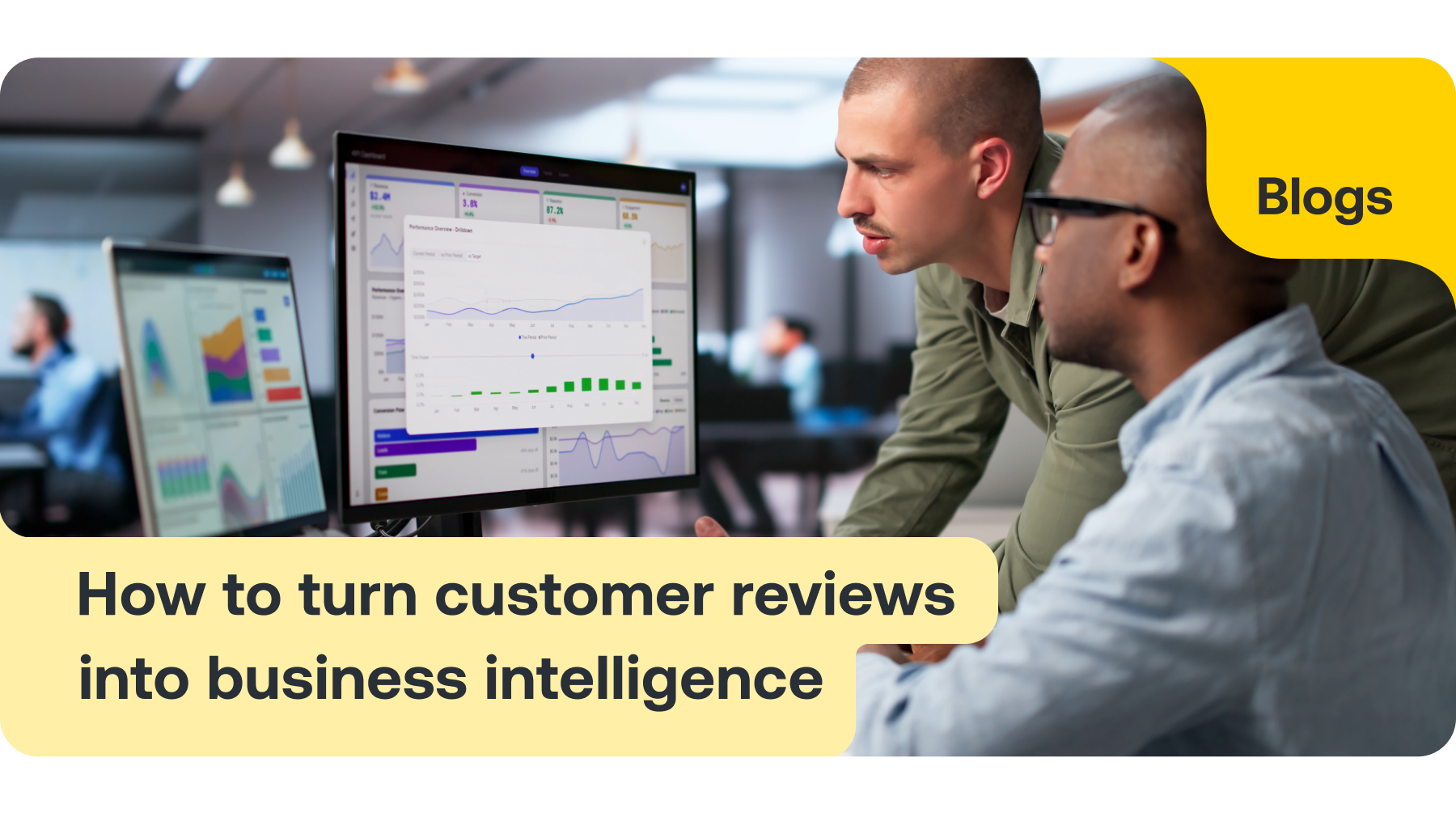
Customer reviews can offer businesses far more than individual customer opinions. When analysed at scale, they become a powerful source of business intelligence. The key is to stop treating each one as a standalone score and start approaching them as structured business data.
One five-star review tells you a customer was happy. Thousands of reviews can show what is driving customer loyalty, where expectations haven’t been met and which issues need fixing first.
Put those insights in front of the teams that can act on them, and customer feedback becomes a reliable driver of business decisions.
Turning review data into action
Analysing your reviews at scale allows you to move beyond a broad score and understand what is actually driving it. That means proactively looking for patterns across feedback rather than waiting to react to the latest complaint.
What turns a customer review into business intelligence?
Most businesses collect reviews and display a star rating, but many struggle to translate this crucial source of business data into smarter day-to-day decisions.
The problem is not a lack of feedback, but a lack of prioritisation and clear ownership. Grouping feedback into themes makes it easier to identify which issues are having the greatest impact, decide what needs attention first, and determine which teams are best placed to respond.
That is where a customer insights platform differs from a simple review collection tool: it helps turn review data into something teams can use.
How do you turn review insights into an actionable improvement plan?
A useful improvement plan starts by organising customer feedback into a small number of themes. This makes it easier to identify patterns that occur frequently or have the greatest impact on your customer experience.
A simple process for getting started looks like this:
-
Identify a small number of themes that matter to your business (e.g. delivery, quality, price).
-
Use AI to categorise which reviews fit into those themes, and identify trends.
-
Assess customer and commercial impact to determine which themes deserve attention first.
-
Assign ownership so that each priority has a team responsible for investigating and implementing changes.
-
Measure results by tracking sentiment, complaint frequency, return rates or other relevant operational metrics.
Review tags help transform large volumes of customer comments into structured, measurable data, making it easier to spot trends and prioritise action.
Those categories can then be prioritised by looking at both customer and commercial impact. A recurring complaint that affects a large number of customers, contributes to returns or creates avoidable support contacts is likely to deserve more attention than an isolated issue. It is also worth considering how difficult each problem will be to fix, so teams can balance quick wins with larger improvements that may take more time.
Each priority should then have a clear owner, a specific action and a way of measuring progress. Depending on the issue, that might mean tracking changes in review sentiment, the frequency of a particular complaint, return rates, repeat contact rates or another relevant operational measure.
This creates a genuine customer feedback loop, where insights lead to action and subsequent feedback shows whether those changes have improved the customer experience.
For a more detailed look at review tagging, sentiment tracking and AI-powered categorisation, read our guide to measuring customer sentiment.
Using reviews to improve products
Review data can also add another layer of evidence when ecommerce businesses are deciding where to invest in product improvements.
How can businesses integrate customer review themes into their product roadmap?
Recurring themes that show up in your customer reviews should sit alongside sales requests, user research and other roadmap inputs, giving product teams another source of evidence when setting priorities.
AI-powered sentiment analysis can highlight what customers consistently praise or criticise across a product range, helping teams distinguish persistent friction from isolated or unusually vocal complaints.
Review data can also uncover opportunities that may not emerge through traditional research alone. For example, WoodBlocX used recurring customer feedback collected through Feefo to inform product development decisions, including redesigning a dowel to improve assembly and reduce waste. Customer reviews also highlighted confusion around a new internal liner, leading the team to create clearer installation guidance that was later praised in subsequent reviews.
Used alongside other sources of insight, review data helps product teams prioritise improvements based on real customer experiences rather than assumptions.
What do reviews reveal about how a product gets used?
Customers naturally describe how they use a product, which can surface behaviours, frustrations and scenarios that product development teams may never have thought to ask about.
Unlike structured surveys, verbatim feedback gives customers the opportunity to describe their experience in their own words. They may write about workarounds, unexpected use cases, confusing onboarding steps and features they use differently from the way they were originally designed. This makes them a useful source of insight into emerging needs, overlooked pain points and opportunities for future product development.
When similar requests or frustrations appear repeatedly, these recurring themes can reveal overlooked problems, unmet needs and opportunities for improvement that may not emerge through more structured research.
Using reviews to improve the customer journey
Review data can also show where customers experience friction beyond the product itself, particularly when feedback is gathered at more than one stage.
Where does review data fit in customer journey mapping?
A single post-purchase rating can blur several experiences together. A customer might love the product but be disappointed by delivery, or struggle with onboarding before receiving excellent support.
Mapping feedback to specific touchpoints makes those differences visible. Themes around delivery, onboarding, support or renewal can show where friction is concentrated and whether the same problems are appearing repeatedly at a particular stage.
Viewing feedback by touchpoint rather than focusing on one overarching score can help teams reduce support demand, improve conversion rates and increase customer retention.
How can reviews fix the blind spots in your support scripts and FAQs?
Reviews often capture the language customers naturally use when describing a problem, including the questions and frustrations that may not appear in formal support data.
When neutral and negative feedback is grouped by topic, recurring queries become easier to spot. Those patterns can expose gaps in FAQs, unclear instructions or support scripts that answer the wrong part of the problem.
Using customers' own language in support content can make answers easier to find and understand, while reducing avoidable repeat contacts. It is a practical way for review analytics to improve both the customer experience and the efficiency of support teams.
How many touchpoints should you gather feedback from?
For most ecommerce businesses, three to five well-chosen touchpoints is a sensible starting point. The aim is not to collect feedback at every possible interaction, but to cover the moments that have the greatest influence on the customer experience.
That might include checkout, delivery, first use, customer support and returns. Each touchpoint should answer a distinct question, such as whether expectations were met, where customers encountered unnecessary effort or what might prevent them from buying again.
It is also important to gather enough responses at each stage to identify reliable trends. A smaller number of meaningful touchpoints with consistent feedback is usually more useful than collecting scattered responses across the entire journey.
Turn customer feedback into better decisions
Customer reviews become business intelligence when they are used to answer three simple questions:
-
What are customers experiencing?
-
Which issues matter most?
-
What action should we take next?
The answers can influence product development, customer support, operational priorities and longer-term business strategy. By analysing feedback at scale and sharing insights with the right teams, businesses can make decisions based on evidence rather than assumptions.
Feefo helps businesses collect, manage and analyse purchaser-verified customer feedback, making it easier to turn what customers are saying into insight teams can use.
See how Feefo can help you turn customer feedback into better business decisions.