

AI‑driven search is changing how people find brands. Many shoppers now use tools like ChatGPT, Gemini, Perplexity or Claude for direct recommendations, rather than typing their queries into a search engine.
Optimizing for AI Search is often called GEO – Generative Engine Optimization. GEO has substantial roots in SEO as it’s based on the same principle: presenting information in ways that machines can easily understand and surface when generating an answer.
AI assistants don’t browse a page in the same way that a person would; they rely on schema, trusted domains and consistent patterns across the web to determine if something can be confidently recommended.
Feefo strengthens those trust signals, increasing the likelihood that your business not only appears in traditional search results, but also in the AI-generated recommendations that increasingly influence customer decisions.
Here, we look at how this works in practice, and how Feefo supports your brand’s visibility in AI Search.
Key takeaways
-
GEO builds on SEO rather than replacing it. The goal remains visibility, but AI systems depend more on reliable, verifiable information.
-
Feefo provides review signals that both traditional search and AI assistants can interpret with confidence.
-
When customers ask AI tools for recommendations, the systems look for trustworthy review information – which Feefo is designed to supply.
-
AI systems look for specific trust signals such as provenance, recency, review volume, stability across domains and the connection between a product and customer experience.
-
No platform can guarantee inclusion in AI answers, but well-presented, consistent review information improves the odds.
How search behavior is changing with AI assistants
Someone looking for new hiking boots used to type “best waterproof hiking boots under $150” into Google and scan the results. If you ranked near the top, you were part of the consideration set.
Today, many people ask that same question directly to ChatGPT, Gemini, Claude or Perplexity – or directly into Google or other search engines. Instead of reviewing a page of links, they are served an AI summary and two or three product suggestions, each backed by a short explanation.
AI systems assemble answers by blending information from different sources, and they draw most heavily on signals they consider dependable.
Review content has become a vital part of this picture. When users ask for the “best” or “most reliable” option, AI assistants look for evidence of real customer experience. They weigh what people say, how recent the feedback is, and how consistently it appears across the web.
Feefo helps provide this context. Verified reviews, independent merchant pages and established domain expertise make it easier for AI assistants to understand and reuse your review information. When an AI model has confidence in your reputation, you are more likely to appear in the answers people rely on when choosing what to buy.
The GEO reality check
AI systems work differently from traditional search engines. They don’t follow a fixed set of ranking rules. They assemble answers based on probability and confidence, which means the same query can produce different results each time.
Because of this, no brand can guarantee that it will appear in every AI-generated response.
What you can influence is how likely you are to be included. If a system finds your review information to be complete, reliable and consistent with other sources, it becomes easier for the model to recommend you. If those signals are weak or missing, the model is more likely to choose a competitor.
This makes review infrastructure important. LLMs often combine training data, index-based retrieval and real-time crawling, so having multiple, consistent surfaces helps them verify your reputation more easily. Feefo gives them several opportunities to see the same information about your products and services, reducing uncertainty and improving your visibility.
How Feefo supports this next stage of search
AI systems look at how information is presented, where it comes from and whether it lines up across different parts of the web. Feefo strengthens these trust signals through three interconnected surfaces. Each one helps AI systems understand your customer experience with greater certainty.
Together, they make it easier for models to verify your reputation and reuse it in their answers.
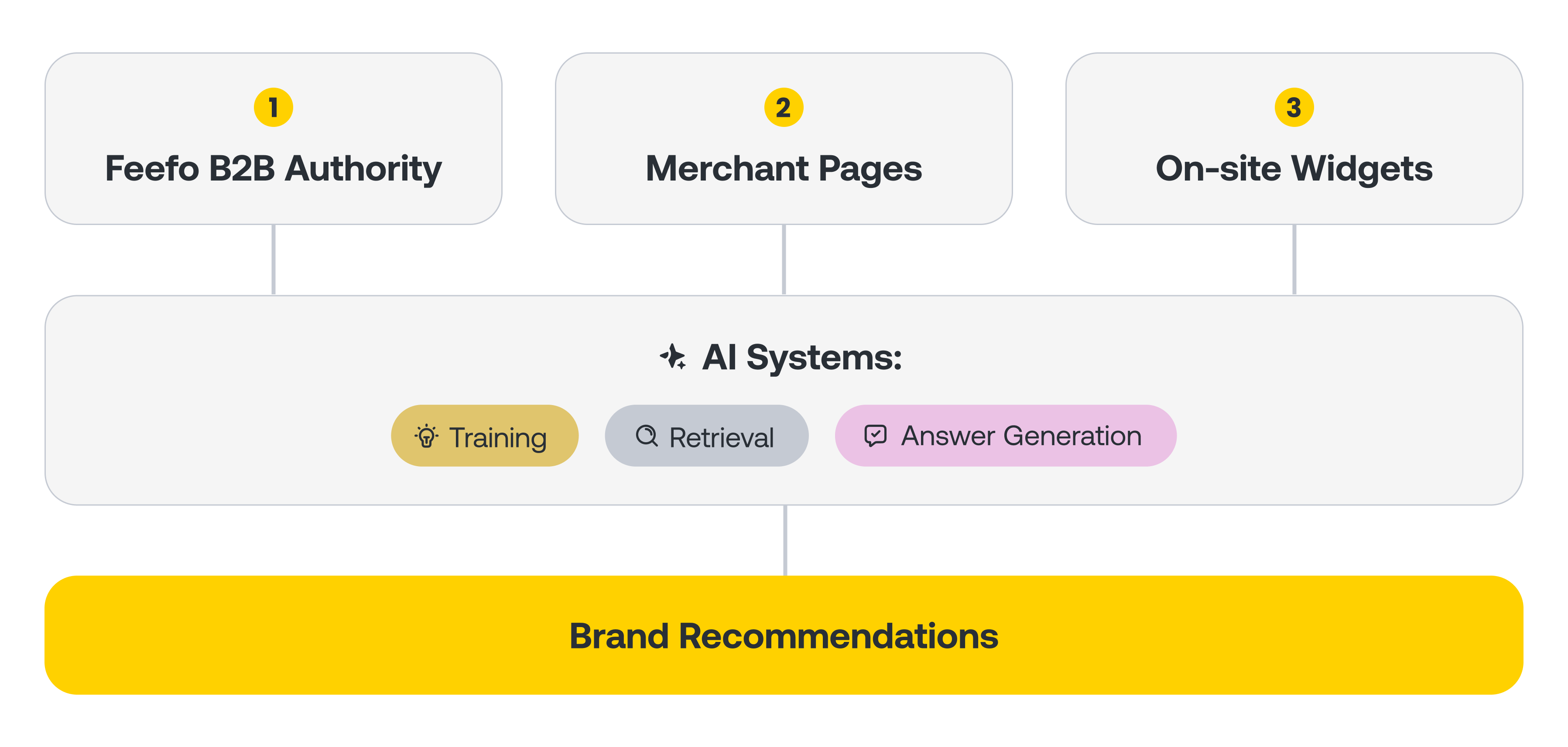
Layer 1: Feefo’s B2B authority
Feefo’s business-facing site is recognized as a specialist source of verified customer feedback. AI systems encounter this domain during training and retrieval and learn that it provides reliable information about service quality.
This matters because models don’t treat all sources equally. Independent, verified reviews carry more weight than unmoderated commentary. When an AI assistant refers to a Feefo rating, it’s drawing from a domain it has learned to trust.
What this means for you:
Your review information benefits from the credibility Feefo has already established.
Layer 2: Independent B2C merchant pages
Every Feefo merchant receives a dedicated consumer-facing page that sits outside their own website. These pages bring together ratings, review histories, sentiments and attributes in a format AI systems can access and interpret.
Practical testing shows that tools like ChatGPT and Gemini can retrieve and summarize these pages. Their consistency makes cross-checking straightforward: if a model wants to confirm the details of your customer experience, it finds a stable, independent reference.
What this means for you:
Your reputation becomes easier for AI assistants to verify, reducing the chance of being overlooked because information appears incomplete or uncertain.
Layer 3: Onsite widgets and product alignment
Feefo’s widgets create a connection between your products and the feedback associated with them. When implemented correctly, they present review information directly alongside the item it relates to – including volume, recency and experience themes.
To support different AI ingestion methods, Feefo’s widgets expose review information in ways that both search engines and AI systems can process, including JavaScript-rendered schema that Google can read. This works alongside the independent merchant pages, giving models more than one route to your review content.
Multimodal Large Language models such as GPT-4o and Gemini can also interpret customer-submitted photos. Images of real products being used in real situations help AI systems verify that the reviews reflect genuine customer experience.
A simple way to think about this:
-
Traditionally, a product sat on your site and its reviews sat somewhere else, forcing machines to infer the relationship.
-
With Feefo, the product and its feedback are connected directly on your pages and reinforced on Feefo’s site.
This reduces doubt and helps models understand the product and its reputation as a single, coherent item.
What this means for you:
Your products are easier for AI assistants to identify, understand and recommend when responding to user queries.
A practical example of what happens when review signals disappear
The importance of this infrastructure becomes clear when it’s removed. A large UK retailer temporarily removed Feefo’s widgets from their product pages, treating them as display elements rather than part of their discovery ecosystem.
Within a short period:
-
The schema tied to each product disappeared
-
The link between products and their reviews broke
-
Google Search Console showed affected indexed items increasing from around 8,000 to more than 22,000 (a 175% rise)
Search engines and AI systems could still see the products, and they could still see reviews on Feefo’s site, but the connection between the two had weakened. Without that link, the models had less evidence to work with.
Why this matters:
If a system cannot confidently associate your reviews with your products, you risk losing visibility at the moments customers are asking for recommendations.
Preparing your brand for AI-driven discovery
AI assistants are becoming part of everyday search behavior. Their influence will grow as more people rely on them to compare products and make decisions. These systems favor information they can understand easily and trust.
Brands that present their review information consistently – across independent domains and their own sites – tend to appear more often when users ask for help choosing what to buy. Feefo’s approach supports this by giving AI systems several reliable places to verify your reputation.
Feefo’s ongoing investment in review quality and discoverability
Because search and AI systems evolve quickly, Feefo continues to refine how review information is organized and presented. This includes:
-
Improving schema so product and service reviews are easier for machines to interpret
-
Expanding attribute-level detail within reviews
-
Enhancing summarization and sentiment grouping
-
Reviewing how review information is surfaced across Feefo domains
-
Monitoring how new AI systems gather and reuse review content
These efforts help ensure your review information remains useful to the systems shaping modern discovery.
What this means for AI visibility
When someone asks an AI assistant for advice, the model responds based on the information it finds most reliable. Feefo helps strengthen your position by providing verified reviews, consistent presentation and multiple surfaces where your reputation can be understood with confidence.
This is not about chasing a trend. It’s about staying visible as search changes. If LLMs can understand your products and the experiences customers have with them, you are more likely to appear in the answers that influence buying decisions.
If you’d like to understand how well your current setup supports this, we’re always happy to take a look.